Easter Sunday Recipe


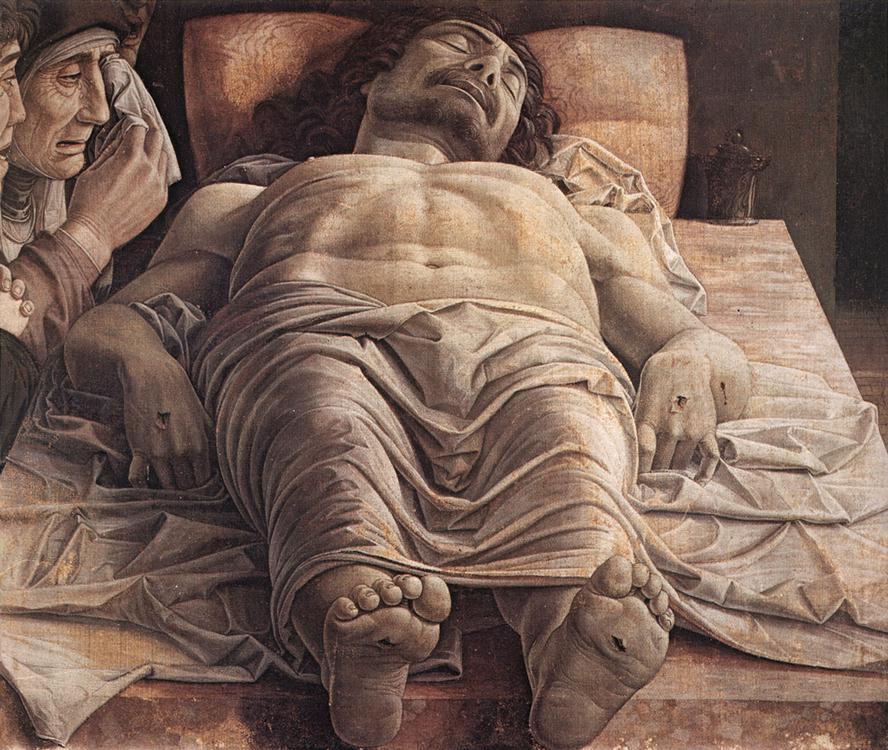
Lamentation of Christ is a beautiful painting and a noteworthy example of foreshortening.

One of the perks of living in a family that celebrates Easter is food. In fact, since no member of my household actually attends church, Easter really is mostly about the food traditions. It was a lonely holiday this year with just my mother and I at home (come to think of it, Christmas was terribly lonely too!), but that did not stop us from making ungodly amounts of food. I thought I'd share one of my favorite holiday dishes. It was passed down from my grandmother to my mother, and my mother to me. It's called "Heavenly Hash." No, not that kind of hash...

Ingredients:

  • 20 oz. can of crushed pineapple
  • 29 oz. can of mandarin oranges
  • 12 oz. jar of maraschino cherries
  • 7 oz. bag of sweetened coconut
  • 1 3/4 bags of 10 oz. "fun marshmallows"
  • 8 oz. sour cream 
Simply drain the fruit, cut the cherries in half, and put them in a large bowl. Add the coconut to taste. After you stir in the marshmallows, you may fold the sour cream into the rest of the ingredients (be careful not to add too much). It's that simple. If you thought I was sharing some sort of secret family recipe, then I'm sorry to disappoint you. 

Comments

  1. It sounds like what we call Ambrosia Salad - my daughter loves it. It's (surprisingly) a little too sweet for me! Although we still make a recipe passed down from my mother every Christmas and Easter - it's one of those jellied salads that tastes more like a dessert than a salad. It's got crushed pineapple, lemon jello, whipped cream and shredded carrots in it. My daughter also loves that. Sweet tooth or what! LOL

    Happy Easter, OddGhoulOut! :o)

    ReplyDelete
    Replies
    1. It's very similar to that, although I've never had proper ambrosia salad.

      Delete

Post a Comment

Popular posts from this blog

Flannery O'Connor and The Christ-Haunted South Lecture

Bedford/St. Martin's For those of you who are not familiar with Flannery O'Connor or her work, let me take a moment to share a little. Flannery O'Connor was a writer born in Savannah, Georgia in the Twenties. She lived most of her life in a town called Milledgeville, also in Georgia. O'Connor's work is categorized as Southern Gothicism . Her wit is legendary, and her stories are characterized by their rural southern settings, grotesque characters, and the strong influence of her Catholicism (rare in the South at the time) on her work. To those of you who have not read anything from this lady, do (and comment with your opinions)! They are accessible online. Here is a link to "The Life You Save May Be Your Own," which is the first short story I read from her. Monday evening after class, my boyfriend and I attended a brilliant lecture at Emory University-- an opportunity  that I hope comes around again. The lecturer was a man named Dr. Ralph Wood. He a...

Decatur Cemetery

Established in 1823, Decatur Cemetery is older than the city of Atlanta itself.  Through the iron gates sprawled pathways lined by stone walls and oak trees. There were monuments of varying sizes and shapes, some worn and peppered with lichen.   Within the cemetery, there are a few mysterious letterbox locations. Letterboxing is a past time similar to geocaching. Participants use riddles to find hidden boxes. Inside the box is a pad of paper that is stamped and dated by the finders. My boyfriend and I trekked through the cemetery to find the hidden boxes. We managed to find one of the three, which was soaked with water. Although we didn't find all, our cemetery exploration proved successful. soaked letterbox, hiding under the tree trunk. Thomas Holley Chivers Upon research, I found that Decatur Cemetery is home to a man named Thomas Holley Chivers. Chivers was a Medical Doctor who became a poet, achieving mild fame at the time. He is famous for his fri...

Let's talk Goth, Consumerism and #zerowaste

Disclaimer:   I do not claim to be an expert on low waste (or "zero waste") living —far from it . The purpose of this piece is to explore what it means to belong to the Goth subculture in the context of consumerism and making sustainable choices. There are many ways to live sustainably, but this piece will focus on reducing waste. This piece does not seek to shame or blame anyone but rather to challenge throw-away attitudes that dominate our world—and the modern Goth subculture—by offering another perspective. Respectful discussion in the comment section is welcomed.  W hen I hear the words "zero waste," I often think of people making videos to show off three months of trash fitting inside a little mason jar, their magical Whole Foods shopping trip, or even a tour of their impossibly-tiny capsule wardrobe. Search #zerowaste on Pinterest and you'll come up with pictures of tidy little beige pantries with uniform mason jars filled with chia seeds, nutri...